Event 1
Hazel and Byron's First Meeting

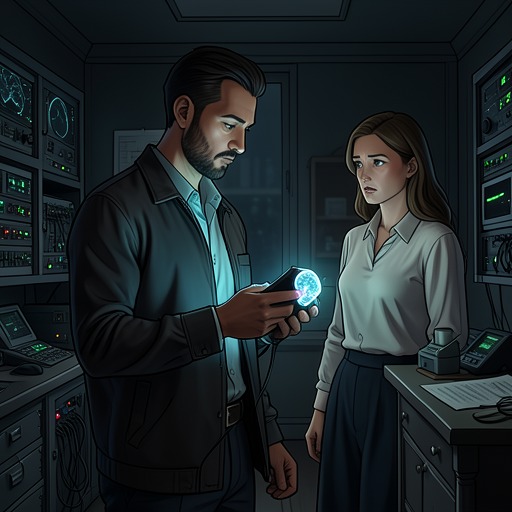
[Hazel and Byron's First Meeting](entity:event-recall-event-hazel-byron-110d8f6e99e2), in [May 2008](entity:time-recall-time-may-2008-9ddb9a4c440b), begins as an improvised campus-newspaper interview and ends with [Byron Gogol](entity:character-recall-character-byron-gogol-96663d0c1b1d) naming a private grief Hazel had never disclosed. The encounter’s decisive turn is not simply that [Byron](entity:character-recall-character-byron-ad5306cf5fcb) notices her: he makes Hazel feel newly legible to someone else, then reveals that he knows more about her than she believes she has shared.
## The Accidental Interview
A college friend had been assigned to interview Byron for the campus newspaper, and Byron was coming to graduation to deliver what he called a digital commencement speech. Hazel had not attended the ceremony, but heard about it through the news and friends who had stayed on course creditwise. Byron, in a suit and sunglasses, invited the graduates to build the speech together: they shouted words for their college experience, their hopes for the future, and their greatest fear about life after graduation. He later recounted the surprising answers to Hazel in an almost flirtatious confidence, including how often graduates chose bawdy terms for those categories.
The planned interview became an accident when Hazel arrived under the name Jenny Roberts. Scanners read the cards in her wallet and checked online information, identifying her as [Hazel Green](entity:character-recall-character-hazel-green-c5bccb2c7d7a) instead. She explained her friend’s predicament and was asked to wait; Byron nevertheless agreed to see her. The false name did not end the encounter. It became part of what made Hazel, to him, difficult to categorize.
## The Interview Turns Around
Byron later explained that Hazel confused him in a fascinating way. He noticed that she was wearing another person’s clothes, but could not tell why, who she was, or what she wanted. The meeting departed from its assigned purpose: although Hazel was supposed to interview him, Byron kept asking her questions until the exchange felt more like his interview of her.
For Hazel, the encounter carried an unfamiliar force. She had never felt that she delighted her parents or herself, but when Byron said her name, Hazel Green seemed newly precise to her—almost upgraded. His attention made her feel intriguing rather than overlooked, and her effort to win his favor was intensified by the impression that he possessed calming existential knowledge she lacked.
## Recognition and Its Unease
At the end of the interview, Byron took Hazel’s right hand and clasped it between both of his. She registered the gesture as evidence that this superrich person liked her; adrenaline surged, followed by a wave of accomplishment and goose bumps. In retrospect, she considered whether his cold skin had contributed to that physical response, as well as the intimacy of his parting words.
Byron apologized that Hazel’s mother was dying. Hazel had not told a single person. The knowledge abruptly changed the meaning of his attention: the man who had seemed delighted by her had also reached a fact she had kept private. The first meeting thus joins attraction and recognition to an unsettling asymmetry, with Byron’s perceptiveness appearing at once intimate and inexplicable.
Event 2
Hazel and Byron’s Wedding
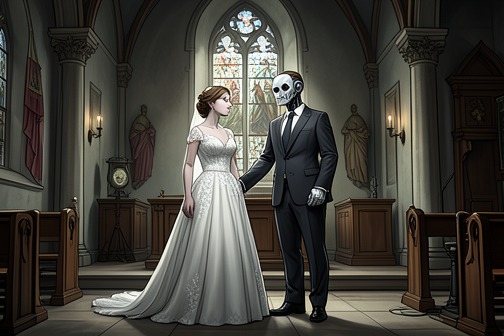
[Hazel and Byron’s Wedding](entity:event-recall-event-hazel-byron-de0b4f8e38f0) grows out of a courtship organized like a business agreement and becomes a marriage Hazel tries, unsuccessfully, to make emotionally real. The robot officiant, the carefully delimited dating period, and [Byron](entity:character-recall-character-byron-ad5306cf5fcb)’s promise of material security all give the relationship a structure; none can supply the love Hazel hoped might eventually develop within it.
## Courtship as an agreement
Byron proposed an initial six-month commitment after showing Hazel supersize projections of photographs from across her life, from yearbook pictures to images taken on a roller coaster. He described traditional dating as incompatible with his schedule and lifestyle and framed the arrangement as an efficient way to pursue a connection he considered undeniable. Hazel, who regarded commitment as a word belonging more to books and advertisements than to her own experience, had little practical sense of what she was being asked to enter.
The terms were explicit. The commitment was not legally binding, Byron said, but Hazel was to take him at his word: they would date exclusively for six months, then evaluate whether to advance, maintain, or dissolve the relationship. The language made intimacy sound provisional and measurable, with a review date built in. Yet the agreement also gave Hazel a defined path into a kind of life she had previously regarded as abstract.
Six months later to the day, Byron proposed. Hazel’s mother had died by then, and the example of her parents had already unsettled Hazel’s ideas about marriage. Her parents had been opposites who fought, but stayed married; Hazel later recalled that she had taken their endurance as evidence that compatibility might not matter if people committed and continued. Their example would help her rationalize her own decision, even though it offered little assurance that commitment could produce affection.
## The wedding and its performance
The wedding’s technology-forward form was Byron’s choice: he insisted that a robot officiate. Hazel later told [Liver](entity:character-recall-character-liver-606050d7064f) that fact first when asked how long she had been married, making the officiant a concise emblem of the ceremony and of Byron’s preferences. For Hazel, the robot also had a practical advantage. The wedding would showcase Byron’s programming, and photographers from technology and industry magazines would be interested in that achievement rather than in her dress.
The dress itself became a small but revealing struggle. Hazel had hoped to find something beautiful, but, after sharing her insecurities about the process with Byron, found that he recruited [Fiffany](entity:character-recall-character-fiffany-df48131f003e) to go shopping with her. Medical problems arose during the process, including hives. They helped determine the choice: Hazel picked the least itchy dress without trying it on, then took enough antihistamine to ensure she would pass out on the ride home. The resulting decision was less a confident bridal selection than an accommodation to discomfort. The ceremony’s public showcase and Hazel’s private experience thus pulled in different directions: the event promoted Byron’s technical accomplishment, while she negotiated the bodily irritation of taking part in it.
## Life inside [The Hub](entity:location-recall-location-the-hub-b9da9c23498c)
During the marriage, The Hub became the couple’s principal home, but Hazel found the word residence increasingly inadequate. The sprawling building was sleek, spotless, and clinical; its walls were equipped with touch and recognition technology. She hardly ever left. Byron spent most of his days at the nearby central office, limited trips away because he equated travel with risk, and returned to sleep at around ten each night with machine-like regularity.
Hazel’s response to the house mixed fascination with estrangement. One of her few hobbies was walking through it with her eyes wide and mouth slightly open, taking in its scale and technological surfaces. She privately imagined it as a holding tank for the dead, a place where departed souls might wait for the afterlife to adjust to a new temperature. That image turns the marriage’s impressive material surroundings into something cold and suspended: a home equipped to recognize its occupants, yet one that Hazel could not experience as fully alive. She never mailed a physical letter during the marriage, but imagined that, if she had, its return address would describe a place where the deceased went to cool down.
## Hazel’s account of why she married
After leaving Byron, Hazel described the marriage to [Jasper](entity:character-recall-character-jasper-a1e1f2fe4259) as something she had not originally planned, but had found difficult to refuse once a multimillionaire proposed. Byron had not seemed horrible at first, she acknowledged; he seemed strange, as other people could be. She also admitted that she had not tried hard to look for what might be wrong. The offer of marriage promised that she would no longer have to worry about most material consequences of life, and that security proved an easy sell.
Hazel did not understand herself as having entered the marriage with no hope of love. She thought she could train herself to love Byron, much as a person might learn to ride a bicycle with initial support and then continue alone. Because she had never been in love, she assumed the task might be manageable, even if she could not imagine its full difficulty. At minimum, she hoped to reach a tolerable stasis: a life that was good enough and free of acute suffering. Her retrospective account therefore describes not simply a marriage of convenience, but an attempt to turn an advantageous decision into an emotional attachment through effort.
She later judged that attempt against the early reality of their relationship. She had realized while they had not been married long that she was not going to love Byron, but did not tell him. People around her considered her lucky, and she expected that she would eventually feel lucky too. She believed Byron deserved a partner genuinely impressed by his genius, rather than someone pretending to be. Her apology, rehearsed for a possible encounter with him, acknowledges both the mismatch and her own concealment: she had tried to love him, but had not been honest when she understood that she could not.
## Separation and the marriage’s public aftermath
The contrast between Hazel’s private account and Byron’s public account becomes sharp after her disappearance. In a television interview, Byron reported her missing and troubled, attributing her condition to grief over her terminally ill father, who had also disappeared. He offered an enormous reward for information and said he feared she had been kidnapped because of his wealth and fame. He described finding Hazel and learning what had happened to her as his highest priority alongside his responsibilities to [Gogol](entity:organization-recall-organization-gogol-6118aef1fc50)’s shareholders.
The interview also disclosed that Byron had filed for an abandonment divorce. He said he believed Hazel would be found, though he had given up hope that she would be found alive, and connected his confidence in eventually discovering answers to the speed of technological breakthroughs. Hazel watched from a modest efficiency motel room and stared at the door bolt; his public performance did not reassure her that he had accepted the separation. His talk of fearless employees was accompanied by a brief glance toward Fiffany, who appeared beside him as a project manager, but the scene establishes no further explanation of their relationship.
The marriage ends, in Hazel’s understanding, without the emotional resolution its formal beginning seemed to promise. Its exclusivity agreement, robot officiant, material security, and highly controlled home had given the relationship clear structures, but Hazel’s later reflections expose the distance between structure and intimacy. Her account neither claims that she loved Byron nor reduces her choice to money alone: she had hoped to make love possible, and regrets that she concealed her failure to do so. That regret accompanies her escape, even as Byron’s public search and divorce filing show that the separation remains contested in practice.
Event 3
Hazel's Mother's Death
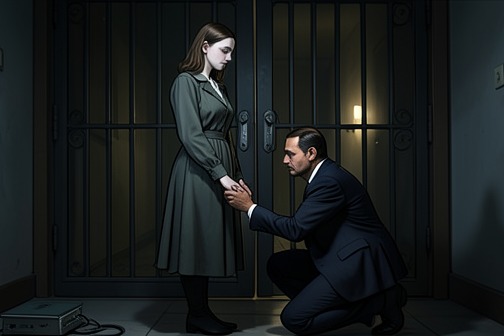
[Hazel's Mother's Death](entity:event-recall-event-hazel-65ad355f1655) occurs during the six months between Hazel's first interview with [Byron Gogol](entity:character-recall-character-byron-gogol-96663d0c1b1d) and his proposal. It is both a family loss and a turning point in Hazel's circumstances: her mother is gone, her father remains at home, and [Byron](entity:character-recall-character-byron-ad5306cf5fcb)'s offer of marriage arrives when Hazel is reconsidering what family life and her own future might mean.
## Timing and Circumstances
At the end of her interview, Byron takes Hazel's hand and tells her that he is sorry her mother is dying, revealing that he knows about a private crisis Hazel has not told anyone else. Six months later, on the day Byron proposes, the narration establishes that Hazel's mother is dead. It does not give the precise date or circumstances of her death; the account instead places the loss within this interval and shows its consequences in Hazel's changing situation.
Her mother's illness and death coincide with a period of instability for Hazel. She has debt and is at risk of failing out of college, while returning to her father's home would mean facing him at a particularly difficult emotional time. Byron's wealth and proposal offer an alternative to that return. Hazel jokes that he has rescued her, and he says she has rescued him too, but the circumstances make clear that the marriage takes shape amid grief as well as attraction.
## Her Mother's Wishes and Family Life
The death also brings into view the choices Hazel's mother made near the end of her life. Before she died, she told Hazel's father that she had been sleeping with Bernie, a widowed friend, for a couple of weeks. He explained that she had wanted to experience sex with other partners before dying, since the two of them had been virgins when they married. Hazel had not known either fact about her parents. Her mother's decision unsettles Hazel's assumptions about her as a parent, exposing an adult life and a marriage history that Hazel had not imagined.
Her mother's wishes extended to what should happen to her body. She asked to be cremated, citing both the effects cancer treatment had had on her appearance and a desire to retaliate against a body that had put her through hardship. The narrative later recalls this request when Hazel considers how to handle her father's remains. Her mother's chosen disposition becomes part of the family's continuing conversation about death, though the account does not specify the arrangements actually made after her death.
## Effects on Hazel
The loss changes the meaning of Hazel's next steps. By the time Byron proposes, the prospect of moving back home is tied to her mother's absence and to the expectation that her father will be harder to live with. Byron's money can relieve her immediate financial pressures, and his futuristic home offers a striking alternative to the life she had expected. Hazel interprets the proposal as a rescue, even as the narration shows that she is entering marriage while grieving and under pressure to find somewhere else to go.
That pressure complicates Hazel's response to the engagement. The proposal does not simply fulfill a settled desire for marriage: Hazel's ideas about marriage have been disrupted by her mother's death and by what she learns about her parents. Her mother's absence is therefore present at the threshold of Hazel's marriage, shaping both the practical appeal of Byron's offer and the emotional ground on which Hazel accepts it.
## Narrative Significance
The event places death beside the promise of a new life without presenting one as a solution to the other. Byron's proposal follows the loss, and its wealth and apparent security contrast with Hazel's debts and uncertain prospects. Yet her mother's death does not resolve those uncertainties; it helps propel Hazel toward a future whose terms she does not fully understand.
The later recollection of her mother's cremation request also gives the death a continuing material presence. Rather than treating bereavement only as an emotion, the novel connects it to choices about bodies, family knowledge, and the forms of farewell people want. Hazel's mother's wishes remain relevant beyond her lifetime, while the revelations about her marriage challenge Hazel's earlier, more limited picture of who her mother was.
Event 4
Byron Proposes a Brain-Chip Connection to Hazel
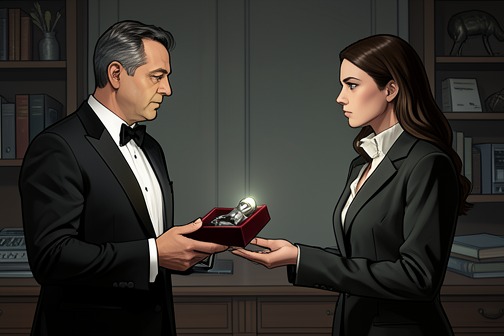
[Byron](entity:character-recall-character-byron-ad5306cf5fcb)’s brain-chip proposal to Hazel turns a familiar romantic gesture into a demand for bodily and neural participation. Remembered by Hazel after she has left him, the scene exposes the gulf between Byron’s faith in technological progress and her refusal to let that faith substitute for consent.
## The Proposed Connection
Byron’s plan was to place a chip in Hazel’s brain and connect it wirelessly to a chip in his, creating what Hazel described as a meld and “the first neural-networked couple in history.” The proposal involved tandem neurosurgical alterations, not simply a symbolic promise of closeness. Hazel later explained that the procedure had never been done and that Byron was effectively asking her to offer her still-living brain for research and development. She had not consented.
## A Proposal Staged as Romance
Byron placed the microchip inside a velvet ring box and presented it in a tuxedo. He got down on one knee, opened the box, and asked, “[Hazel Green](entity:character-recall-character-hazel-green-c5bccb2c7d7a), will you meld with me?” The gesture borrowed the recognizable choreography of a marriage proposal, but the object inside the box made the stakes radically different: the commitment he wanted was a physical alteration that would link their brains.
Hazel did not respond with the expected joy. Byron remained on one knee through the argument that followed, holding out the box as though the pose itself could persuade her. He appeared to interpret her refusal as temporary shock at an overwhelming offer, and waited for her to change her mind. Hazel instead turned and left, crying and disgusted, while he called after her to stop and think. His insistence culminated in the question, “[What is love if not progress](entity:expression-recall-expression-what-is-love-if-no-60e7c637930f)?”
## Recollection and Significance
The proposal returns to Hazel as a memory when, during her escape, she sees a lawn flamingo’s raised leg and plastic shape as resembling Byron kneeling. The incongruous garden ornament brings the carefully staged scene back to her amid her difficult attempt to cross the street. She pounces on the flamingo and uses it to help herself walk, turning the remembered image of Byron’s proposal into an object she can physically seize and move with.
The scene’s central conflict is not a disagreement about whether the two are in love, but about what Byron is entitled to ask of Hazel’s body. His language makes technological progress the measure of love; her departure rejects the assumption that an intimate relationship, or a polished romantic ritual, can make an untested brain procedure acceptable. The memory also clarifies why the proposal becomes inseparable from her later fear that Byron intends to control what happens to her mind.
Event 5
Hazel Leaves Byron and Seeks Refuge with Her Father
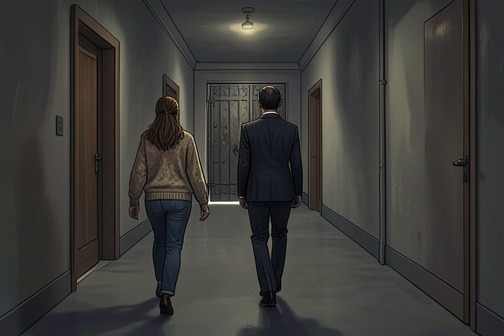
[Hazel Green](entity:character-recall-character-hazel-green-c5bccb2c7d7a)’s departure from [Byron Gogol](entity:character-recall-character-byron-gogol-96663d0c1b1d) is an act of escape made without a financial or practical safety net. She leaves with no available funds or identification and turns to her father for shelter, while fearing that [Byron](entity:character-recall-character-byron-ad5306cf5fcb)’s power and reach make the separation dangerous. The event shifts her immediate aim from enduring the marriage to trying to build a life independent of it, but the refuge she seeks remains uncertain and costly.
## Departure and Immediate Stakes
Hazel leaves Byron on the morning she arrives at her father’s home, taking none of the money or identification available to her. The choice is not presented as a prepared transition: she admits that she has not planned far ahead, and explains that leaving without taking anything had seemed necessary. She had become frightened that morning, and a troubling incident involving blood had helped make the decision immediate. Her exit therefore begins not with a secure plan for independence, but with the urgent need to get away.
The loss of ordinary resources makes the request for shelter consequential. Hazel asks her father to let her stay until she can support herself, initially imagining a year as a reasonable period in which to begin a new life. She is aware that this request may place a burden on him. At the same time, she believes Byron poses a real danger, so returning to the life she has left is not a simple alternative. The separation is both a bid for protection and a predicament: Hazel must seek help from family precisely because she has left without the means to establish herself alone.
Her disorientation appears even in how she looks at the objects around her father’s living room. A crate prompts her to wonder whether sleeping inside it might be easier than sleeping in a bed with room to move. She imagines the fixed limits of the box as a way to stop searching for the right position and simply switch off, like one of Byron’s devices. The thought connects her exhaustion to the technological household she has left, while making her wish for rest seem as immediate as her wish for freedom.
## The Reason for Leaving
In explaining herself to her father, Hazel identifies the proposed brain-chip connection as a decisive reason for her fear. Byron had wanted them to connect a chip in his brain with one in hers, creating a shared neural network. Hazel describes the arrangement as a first-of-its-kind union, but the idea of technological intimacy does not reassure her: it intensifies her sense that her body and mind could become subject to Byron’s control. The escape is thus not simply a departure from a wealthy, eccentric husband. It is a refusal of a marriage in which closeness could be engineered as a form of access.
The danger she associates with Byron is also tied to the imbalance between them. He founded and built a technology empire, and Hazel understands his wealth and power as immense. Her father initially responds as if the proposed chip were a tracking device; Hazel clarifies that the intended connection was more extensive, a shared system between their brains. That exchange shows how difficult it is for her to make the threat legible to someone outside the marriage. The plan is not an ordinary marital disagreement, and she has no straightforward language for the degree of access it would entail.
## Seeking Her Father’s Protection
Hazel’s appeal to her father combines fear with the admission that she has no complete plan. She says she expects to stay only until she can make it on her own, then tries to put a boundary around the uncertainty by asking for a year. Her father answers that he might die before that time is up. His response brings the fragility of the refuge into the conversation: Hazel is asking for a substantial stretch of support from someone whose own future she cannot take for granted. The exchange does not establish that he agrees to the proposed year, so the request remains a plea rather than a settled arrangement.
The conversation also exposes the strain of asking for help. Hazel worries that her father thinks she is spoiled and recognizes that he has reason to see her as cowardly in some respects. But she rejects the implication that leaving Byron is an overreaction, pointing to the brain-chip proposal as the fact her father has not yet understood. Her flush and her effort to explain herself mark the personal cost of having to justify an escape that she regards as necessary. The immediate question is not whether she has made a perfect plan, but whether her father will recognize why she cannot safely continue as before.
## Fear and the Unsettled Break
Even after leaving, Hazel does not experience herself as secure. When she later shuts her father’s door, she imagines searching around its perimeter for somewhere to hide and worries that Byron may retaliate through technology rather than direct confrontation. These fears are presented as Hazel’s expectations, not as proof that Byron has acted against her. Their force comes from the history she associates with him: she has spent years as his audience and test subject, living under internal and external surveillance and growing to hate and fear him.
Yet the departure is not only an attempt to avoid harm. Hazel says she wants to live long enough to discover what independence might feel like, including its pleasures as well as its problems. She recognizes that marrying Byron had offered an escape route, but now wonders what life might have been if she had not taken it. Her hope is tentative rather than triumphant: she does not know whether life without him will become contentment, or whether she and her father can sustain the refuge she has requested. The event’s decisive change lies in that uncertainty. Hazel has left the relationship and begun to imagine a self beyond it, but safety, shelter, and a viable future remain unresolved.
Event 6
Jasper Scams Elizabeth and Breaks Up with Her
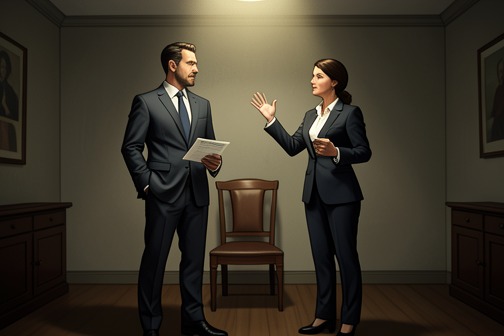
[Jasper Scams Elizabeth and Breaks Up with Her](entity:event-recall-event-jasper-elizabeth-a9625fec7006) is a [May 2018](entity:time-recall-time-may-2018-7b574477747c) episode in which a manufactured romance becomes a financial con and a clean escape for its perpetrator. [Jasper](entity:character-recall-character-jasper-a1e1f2fe4259) persuades Elizabeth to hand over her entire $38,000 401(k), ends the relationship once the money clears, and watches her discover that the transfer leaves her with little leverage. The scene’s sharpest reversal is not simply that he has lied, but that the language of commitment has helped make the money irrecoverable.
## The promise and the payday
Jasper presents the money as support for his first year of medical school. His pitch binds a practical investment to a promised future: once he graduates and becomes a doctor, he will repay Elizabeth with interest, and the two of them will be married. He had made the proposal sound imminent, even suggesting that he would ask her at once if he could already provide for her. The promise of eventual marriage turns the transfer into something that seems to belong inside a shared life, rather than a payment to a stranger.
The money is Elizabeth’s entire current retirement account, not a small loan. Jasper waits until the $38,000 check clears before sending a breakup text. He then destroys his cell phone and buys another, severing the channel through which she might reach him. The order matters: first the funds become his, then the relationship ends, and then he replaces the device that connected them. What he calls a successful payday is built from a sequence designed to make his departure harder to interrupt.
## Elizabeth finds him
Elizabeth nevertheless tracks Jasper to the motel where he is staying and locates his actual room. The narration speculates that she may have called in help from Dana, a friend who works in one of [Gogol](entity:organization-recall-organization-gogol-6118aef1fc50)’s data-research divisions, but leaves the precise means of discovery uncertain. At the motel, Elizabeth repeatedly hurls herself against his window. The impacts shake the wall; Jasper estimates that she has kept at it for the length of two episodes of Law & Order. He initially stays behind the curtain, then draws it back and watches her through the glass.
Her pursuit has left her sweaty and disheveled, with blood running from a small cut near her scalp. She calls Jasper a sociopath and threatens to call the police. He stays calm and tells her that breaking up with her is not illegal. His composure depends on treating the confrontation as a problem already solved: he believes the police cannot undo the transfer, and that Elizabeth’s anger will not change what he has arranged. Behind the window, her frantic physical effort meets his deliberate stillness.
## The transfer’s concealed terms
As Jasper watches, he sees Elizabeth understand the gap between what she thought she had done and what the transaction can establish. She sent the money in a single wire transfer as a gift. There was no false guarantee of an investment and no paperwork trail documenting a scam. The distinction protects Jasper in the immediate scene: the promise of repayment and marriage shaped Elizabeth’s decision, but the transfer itself does not preserve those promises as formal terms.
Elizabeth begins to weep. Jasper closes the curtain rather than reopening the discussion. From outside, she threatens that he will spend his life looking over his shoulder; by then she is crying, and he interprets that change as the beginning of grief. His attention remains fixed on what her loss means for him, including the end of their sexual relationship. The episode makes the consequences uneven: Elizabeth has lost her savings and her belief in the relationship, while Jasper can withdraw from the encounter behind a pane of glass.
## Intimacy as cover, escape as strategy
Jasper admits to himself that sex with the women he deceives is not unpleasant for him. He enjoys it, does not have to fake arousal, and wishes that it felt more like work. He recasts this capacity as a talent that ought to earn him a living, even describing his acceptance of different bodies as a kind of feminism despite recognizing that he does not share the ideals he attributes to women. His self-justification does not soften the central fact: he had sex with Elizabeth to obtain her money, while his pleasure made the performance easier to sustain.
A relationship without a secret agenda holds little appeal to him, and vulnerability disgusts him. He connects that aversion to the damage he associates with his father’s multiple divorces, imagining emotion as a force that has left a person blurred and liable to give way without warning. That explanation offers context for his distrust of intimacy, not an excuse for the deliberate deception he has just carried out.
After Elizabeth, Jasper considers changing the conditions of his flight. A television program showing a crash-test dummy sled into a tree prompts him to wonder why he should not go somewhere colder. He has lived in the South and had not imagined leaving its humid heat, but he recognizes that winter resorts may offer what beach communities offer him: transient residents, anonymity, professionals, and wealthy potential targets. Crossing a state line may not be enough to lose Elizabeth’s trail. The breakup therefore ends not with remorse or repair, but with Jasper turning the danger of being found into a reason to relocate.
Event 7
Jasper Is Attacked by a Dolphin and Rescues It
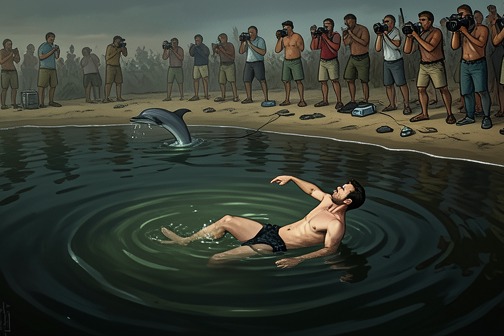
[Jasper Is Attacked by a Dolphin and Rescues It](entity:event-recall-event-jasper-3aa8e3bf38f6) is a violent beach encounter that turns an attempted retreat into an unlikely rescue and a public spectacle. [Jasper](entity:character-recall-character-jasper-a1e1f2fe4259) enters the water wanting silence and escape; after a dolphin batters and submerges him, he fights back to the shore with the animal, only to find a crowd recording him. The episode’s reversal—from helplessness in the water to anonymous celebrity on land—begins a new public identity he neither sought nor welcomes.
## The Sunset Swim and First Blow
Jasper has decided to leave and take in one last sunset by the ocean before packing up. The sun appears to melt smaller and thinner toward the waves, while the heat remains trapped overhead. He walks into the water until it rises to his shoulders and chin, then goes limp and floats. With his ears submerged, he enjoys what he calls a “lobotomized feeling”: the outside world disappears beneath the steady beat of the water. In that suspended quiet, his groin begins to swell with a halfhearted erection.
The solitude ends when something strikes him in the face with enough force to drive his whole body beneath the surface and slam him into the ocean floor. Jasper knows he should panic, but initially finds movement difficult. In his head, an affectless female voice repeats “suffocation,” pronouncing the word with the composure of a spelling-bee contestant. The mismatch between the calm voice and his bodily danger makes death seem almost seductive: he imagines it encouraging him, in an arousing tone, to stop fighting. Gradually his limbs return, tingling and painful, and he manages to sit up and reach the surface for air. The attacker remains unknown, leaving him to wonder what has happened.
## Repeated Attack and the Dolphin’s Reveal
When something noses his groin, Jasper interprets the danger through his fear of Elizabeth. He imagines her in scuba gear on the ocean floor, holding piano wire and preparing to castrate him. His immediate objective is simply to get back to shore, but as he starts swimming he feels himself painfully goosed and is launched several feet forward, his head driven underwater. In raw distress, he cries, “Moley E., please!”—accidentally using the secret-joke name associated with Elizabeth. His panic rapidly turns the slip into a fresh imagined catastrophe: he thinks he has convinced her to take his manhood and pictures himself ending his life as a eunuch. He even wonders whether a tender appeal to her by name might have changed the outcome.
The next assault is more sustained. Jasper is pulled under again as repeated, heavy thrusts strike his torso and hold him beneath the water. Nearly a minute passes before he can identify what is attacking him. His vision dims pale pink at the edges as oxygen deprivation sets in; he briefly welcomes the fading sensation as a chance to rest. The assailant is neither Elizabeth, a shark, nor another imagined monster, but a dolphin. Jasper recognizes the animal by its exterior even as he cannot understand why it is attacking him. The abrupt identification replaces the threat he has been inventing with a real, forceful animal encounter.
As he nears asphyxia, his mind turns to an earlier dental appointment. He recalls a hygienist helping him breathe through a nitrous oxide mask and remembers having entertained the possibility of intimacy with someone who seemed capable of taking charge and giving him a break from his performed routine. But when she drew close, he asked about her annual income and dismissed the prospect of flirting because he thought she did not earn enough. She put the mask back over his mouth, and the dalliance ended. In the present crisis, that memory brings together his longing to relinquish control and the calculating habit that interrupted it; the recollection does not stop the attack, but it occupies his mind while his body is running out of air.
## Hauling the Animal Ashore
After surviving the underwater struggle, Jasper decides that the dolphin cannot simply be left in the sea. He worries that it may have exchanged pathogens with him and reasons that the aggressive animal needs testing. His thoughts jump between possible ways to transport it: the trunk of his car, a rope tying it to the roof, or a direct trip to the emergency room. He also frames the day as a run of bad luck, linking the encounter to his earlier distress at seeing Elizabeth after their motel episode. Reaching land, he thinks, would let the strange day end and allow him to wake feeling lucky again.
Getting the dolphin to shore becomes an ordeal in its own right. The animal feels impossibly heavy, and Jasper is exhausted by the battle, whose duration he cannot estimate. As he shuffles forward, the dolphin’s glossy back reflects his face. Jasper recoils at the sight: he looks old. For a moment he cannot accept the reflection as his present appearance and reads it as a glimpse of his future, at odds with the eternally young self-image fixed in his mind. Despite the weight of the animal and his bleeding wrist, he keeps staring. The rescue thus carries a private shock alongside its physical burden: Jasper confronts an image of age that his usual self-conception has excluded.
When he finally looks up, the two are no longer alone. A line of people fills the shore, their arms extended toward him, each holding a [Gogol](entity:organization-recall-organization-gogol-6118aef1fc50) cell phone to take photographs or video. A woman cries, “You saved the dolphin!” Jasper tightens his shoulders and answers, “No big deal,” minimizing the feat even as the crowd turns it into a scene. His modest phrase will soon become the caption attached to his image.
## Anonymity and the Viral Rescue
Jasper places the living bottlenose dolphin on the sand and runs as soon as he can. His legs shake with exertion, but the crowd gathers around the animal, assuming that he has gone to get help; their attention gives him the chance to slip away. A bystander offers him a ride to an ocean-creature clinic in exchange for gas money, but Jasper does not stay to accept it. He returns to his old motel room without being followed, with the dolphin itself serving as a distraction from the man who had carried it ashore.
That night Jasper wakes in time to see himself on the local news. An elderly woman compares the rescue to a pietà, reenacting his emergence from the water with her arms and likening him to Jesus carrying a dolphin; an intoxicated tourist in the background announces that he is on television. The coverage reports that the dolphin is in good health, had become separated from its pod, and might have stranded farther down the shore without the intervention of the unidentified man now being called “Dolphin Savior.” Jasper has not yet been identified, but the story has already spread online. A photograph of him holding the dolphin bears the words “NO BIG DEAL,” and a five-second clip of him saying the phrase has millions of views.
The coverage makes Jasper’s escape from the beach temporary: though no one knows his name, the image of his wet shorts and the rescue has made him an object of public attention. News commentators speculate about his appearance and joke about staging a rescue to meet him, while Jasper wonders what is wrong with everyone and recognizes that he will not solve the riddle. He chooses to rest before an incognito relocation the next day. The encounter has therefore produced an irony more consequential than a fleeting headline: Jasper saves an animal while trying to get away from the scene, then discovers that the rescue has made him famous precisely when he wants to disappear.
Event 8
Impostor Rises to Fame as "Dolphin Savior"

The rise of [Dolphin Savior (Impostor Singer)](entity:character-recall-character-dolphin-savior-c8c17428860b) begins with a real rescue and an image that quickly escapes its subject. [Jasper](entity:character-recall-character-jasper-a1e1f2fe4259) carries a dolphin to shore and runs off, but a crowd records him on [Gogol](entity:organization-recall-organization-gogol-6118aef1fc50) cell phones; a photograph and a short video of him saying “No big deal” spread widely. News outlets report that the dolphin is healthy and had become separated from its pod, while the unidentified rescuer is given the name Dolphin Savior. The fame that follows belongs first to Jasper’s recorded image, then to a stranger who claims it as his own.
## The Rescue Becomes a Media Story
The initial footage makes the rescue legible as a compact public story: a man helps a dolphin, declines attention, and disappears. Jasper’s departure helps the image circulate rather than ending the story. Viewers and reporters fill the gap left by his unknown identity, and the nickname Dolphin Savior supplies a name that can travel before anyone knows who the man actually is. Within hours, the clip has millions of views and the photograph bearing the words “NO BIG DEAL” has become a widely shared meme.
The media attention also turns Jasper’s appearance into part of the story. A news anchor comments on his looks, and commentators speculate about staging a false emergency to attract him. Their banter treats the recorded rescuer as both a news subject and a possible object of fantasy. Jasper, watching from his motel room, finds the public response baffling. He has not chosen to become famous, and the footage’s circulation makes his anonymity harder to protect even before his name is known.
## A Search and a Borrowed Identity
When Jasper later sees the coverage, several men have come forward claiming to be the rescuer. Some resemble him more than others; one is notably older and missing many teeth. The broadcast checks the claims against the available images, including the absence of tattoos on the man who actually carried the dolphin. This succession of impostures underscores how little is needed to enter the story: the viral clip has made the role recognizable, while the person inside it remains unidentified.
The eventual claimant offers a more elaborate account. As Jasper learns from [Tiny](entity:character-recall-character-tiny-9d42cb1cc18b) at the [Oceanarium](entity:location-recall-location-oceanarium-2724b404a581), the man says that he suffered a concussion on the day of the rescue, temporarily lost his memory, and only later remembered what had happened. He presents himself as a singer-songwriter who had written a personal song about the experience without originally planning to release it. The explanation supplies a ready-made bridge between the mystery of the disappearing rescuer and the singer’s sudden emergence. Jasper, who knows the rescue was his, sees the tale not as an inspirational coincidence but as a fabrication.
## The Song and Its Image
The impostor’s music video makes the transformation explicit. It opens with a computer-generated dolphin in a hospital operating theater, then shows the singer in surgical clothing approaching the animal. A crystal heart inside the dolphin contains an image of Jasper holding it. The video borrows the rescue’s recognizable subject while replacing the actual rescuer with its own performer; the real footage has become raw material for a more polished and commercially useful fiction.
The song, titled “[Saving You Saved Me](entity:expression-recall-expression-saving-you-saved-m-4805ced47e83),” becomes a hit. Jasper recognizes its melody from music that had played in the Oceanarium food court, though he had not previously attended to its lyrics. The impostor’s success reaches Jasper directly when he learns that [Bella](entity:character-recall-character-bella-e7bb6f6c0c73) is expected to perform a new routine for the singer’s concert. He imagines that the event may reproduce the aquatic-show photo opportunity, this time giving the false rescuer access to the dolphin at the center of his manufactured fame. The deception therefore does more than rewrite the past: it begins to shape plans in Jasper’s present.
## Followers, Celebrity, and Consequences
The singer’s public identity extends beyond the song. His fans call themselves melon heads, and he refers to them as followers. Tiny describes a movement with religious overtones, whose members travel along the coast to attend concerts and organize around finding things to save. Their examples range from collecting discarded objects to capturing insects for release elsewhere. Tiny regards the impulse to help as potentially worthwhile but questions the group’s methods and the celebrity culture built around them. Jasper, meanwhile, sees the movement as evidence that a false story can become a persuasive public identity once it is repeated and given an audience.
The episode also places the impostor within a larger entertainment circuit. A prominent interviewer who has made celebrities emotional—including the pop star known as Dolphin Savior—later interviews [Byron](entity:character-recall-character-byron-ad5306cf5fcb) about Hazel’s disappearance. That connection shows the rescued dolphin story’s continuing presence in celebrity news, even as the identity at its center has been appropriated. Jasper remains absent from the public account, relieved that no one is searching for him while also angered by the success of the fraud. The event’s central reversal is not that the rescue proves false, but that its genuine rescuer disappears while another man receives the name, song, audience, and career built from it.
Event 9
Byron Reveals the Brain-Monitoring Chip to Hazel
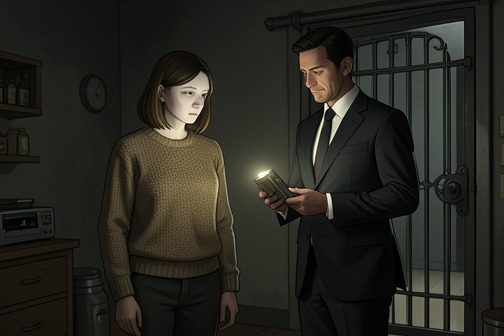
[Byron Reveals the Brain-Monitoring Chip to Hazel](entity:event-recall-event-byron-hazel-b663eb02257a) is the confrontation in which Hazel discovers that [Byron](entity:character-recall-character-byron-ad5306cf5fcb) has been accessing information from her mind through an implant she did not know she carried. What first appears to be a dispute over whether he has somehow watched her becomes a disclosure of the mechanism behind his knowledge: a hidden chip, periodic downloads, and a corporate plan to make her cooperation part of a public story about marital closeness. The revelation transforms Hazel’s earlier suspicions about domestic monitoring into evidence of an intrusion she cannot escape simply by leaving home.
## Background: Surveillance Inside [The Hub](entity:location-recall-location-the-hub-b9da9c23498c)
The disclosure has roots in Hazel and Byron’s marriage, when monitoring in The Hub gradually came to feel claustrophobic. Byron had reassured Hazel that the sensors were innocuous, asking in effect what she had to hide and what harm they could do. But his knowledge of her daily activities while he was away, and the changes to meals delivered by staff in response to bodily scans she had not known were taking place, made the monitoring harder to dismiss as an abstract convenience.
The system extended beyond the sensors Hazel initially understood. Byron eventually admitted that cameras and scanners were present in every room, including the bathroom, and that no part of her time inside The Hub had gone unrecorded. He defended the collection of data as useful for safety, convenience, and health. He also claimed that processing Hazel’s words and actions could reveal her state of mind with almost ninety-seven percent accuracy. The gap between those assurances and the breadth of surveillance was already a conflict over who could know Hazel’s private life, and on whose terms.
## The Call and the Disclosure
During a later phone call, Byron asks how the download managed to find Hazel. She initially rejects the idea that information has been taken from her brain and says she has checked for a scar. Her doubt weakens when Byron demonstrates knowledge of a private incident at her father’s house that she has not told him about. Hazel asks whether he placed cameras there. Instead of describing a camera in the house, Byron explains that her mind is the camera. When he invites her to ask about anything she has seen, thought, touched, or smelled in the previous day, he makes clear that his knowledge is not limited to what she has consciously shared with him.
The call confirms that an implant is present in Hazel’s brain and that Byron has downloaded the previous twenty-four hours of her experiences and thoughts. He says the implant has been there for some time, that its insertion left no scar, and that he had hoped not to activate it. He claims that he turned it on after Hazel left because he missed her. His account presents the surveillance as an expression of attachment, but the practical effect is to make her departure no guarantee of privacy.
## From Monitoring to Control
Byron warns Hazel that the prototype has no active GPS because such a system would be detectable. Instead, each download provides her exact coordinates. He describes a possible twenty-four-hour lead before the next download, but says she could not keep outrunning the people who could use that information. This turns the daily transfer of data into a means of locating Hazel as well as observing her: the device need not continuously broadcast for her movements to remain trackable.
He also proposes replacing the periodic downloads with a real-time stream from Hazel’s brain to his. The arrangement would not be mutual; Hazel asks whether she would be able to see his thoughts, and Byron says she would not, citing the sensitive information he handles. He argues that the implant is proprietary technology calibrated to Hazel’s physiology, backed by years of data and research, and too valuable for his company to leave unused. He raises the possibility that competitors could discover the technology and abduct her, framing her noncompliance as both a business risk and a danger to her own security.
Byron’s proposed public explanation makes the personal and corporate stakes explicit. He points to their decade-long marriage as an established social fact and argues that people trust love and romance more readily than unfamiliar technology. Presenting the brain connection as an extension of their relationship, he reasons, would make it seem intimate rather than invasive. Hazel’s marriage is thus not only the setting for the monitoring: Byron treats it as part of the product’s potential public credibility.
## Objects, Aftermath, and Significance
The call also casts earlier electronics Byron had left for Hazel in a different light. He had placed basic equipment in a weatherproof safe in her backyard, using their anniversary date as the code. Hazel refuses to open it and says she does not want to use electronics or accept his money. Later, when she tries to sell items from the safe, a buyer identifies them as embargoed [Gogol](entity:organization-recall-organization-gogol-6118aef1fc50) products, worth more because they are customized or contain unreleased or sensitive features. Hazel realizes that the gifts may carry surveillance enhancements. The safe’s contents therefore appear less like a route to independence than another point of contact with Byron’s technology and company.
After leaving Byron, Hazel takes precautions against being located through digital traces. At a library, she avoids signing into accounts under her former identity and avoids searching for Byron, [Fiffany](entity:character-recall-character-fiffany-df48131f003e), or herself, reasoning that a search could help one of his algorithms find her. She instead scans news headlines, learning that Byron and Fiffany are now together. Her evasions do not undo the disclosure; they show how it alters ordinary choices about communication and visibility. The chip makes privacy a continuing problem, while the corporate systems around it give that problem consequences beyond the marriage.
The decisive turn is from suspicion to confirmed knowledge. Hazel had tried to treat the download as a story Byron wanted her to believe; his specific access to an unshared experience, followed by his account of the implant and its operation, strips away that explanation. The episode exposes an unequal arrangement in which Byron can collect and interpret Hazel’s private data while withholding his own, then recast that asymmetry as love, safety, and commercial necessity. Its central consequence is not simply that Hazel learns she is being watched, but that she understands her body and her marriage have been made part of a system designed to preserve Byron’s access to her.
Event 10
Hazel Tries to Stop Brain Downloads with a Sleep Helmet
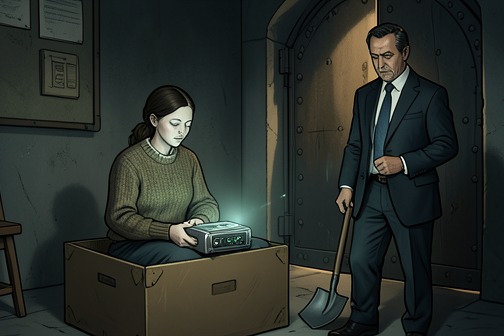
[Hazel Tries to Stop Brain Downloads with a Sleep Helmet](entity:event-recall-event-hazel-1452e4c88924) is Hazel’s attempt to use [Byron](entity:character-recall-character-byron-ad5306cf5fcb)’s own Sleep Helmet as a barrier against the brain download scheduled for noon. The effort fails: after the helmet’s calming induction, images of Byron arrive with punishing force, and Hazel climbs out of the box shaken. The scene makes the threat of the download tangible while showing Hazel trying to regain some control over when and how it reaches her.
## The Deadline and the Idea
The next morning, Hazel wakes without knowing the time. [Liver](entity:character-recall-character-liver-606050d7064f) does not know either, and the uncertainty matters: Hazel needs to get home before the next download at noon. The deadline gives her idea its urgency. Rather than waiting for the download to arrive without resistance, she decides to test whether the Sleep Helmet can interfere with it.
Her plan is improvised, not assured. Hazel asks Liver to help lift something, and he wonders whether it is a body, eyeing a shovel in the shed as if preparing for a very different task. On the way to Hazel’s house, he retrieves a full flask from between the truck’s seat cushions and calls it necessary equipment. The exchange gives the plan a grimly comic edge, but Hazel’s request is practical: she needs another person to move the box, even as she does not want him to witness what the download might do to her.
## Setting Up the Test
At home, Hazel’s father and [Diane](entity:character-recall-character-diane-7eda724cf980) are playing cards in the kitchen breakfast nook. Hazel tells her father that a friend is coming to bring Diane’s box to the porch, and warns him not to judge Liver by his appearance or consider him dangerous. The domestic scene continues around the attempt: her father calls out that Diane has won at rummy again while Hazel prepares for the approaching download.
Hazel fetches the Sleep Helmet Byron had put in the safe. She doubts that he would have included it if wearing it during the downloads could prevent them, but she treats that doubt as a reason to test the possibility, not to abandon it. She wonders whether sleep might make her mind less susceptible to having memories ripped out, and wants to try every roadblock she can muster. The helmet’s presence in the safe ties the experiment to Byron, while Hazel’s reasoning remains focused on finding any practical means of resistance.
She tells Liver that she intends to put on the helmet and climb into the box for a few minutes. She cannot predict exactly what will happen and asks him to wait in another room. Liver asks whether she will shut the lid; his question makes the physical arrangement plain. Hazel confirms that she will and asks him to help. Before she climbs in, he says he will poke airholes for her health. The brief exchange offers a small measure of care, but it does not make the test less isolating: Hazel wants help with the box, yet does not want Liver beside her when the download comes.
## The Helmet and the Download
Hazel puts on the helmet, climbs into the box, and lies back. Liver makes the airholes as promised. The helmet blocks out all light; Hazel hears a series of terrifying stabs in near-mechanical succession, followed by silence. She presses the activation button and starts the helmet’s beta-wave sequence.
The induction feels pleasurable, and its ease frightens her. Hazel’s recurring image is not a peaceful landscape but a zookeeper cleaning the cement floor of a cage: a large push broom moves over soapy ground, its rasping polymer bristles traveling from the room’s center toward its edges. As that motion recedes, her worries seem to go with it. The image thins into the liquid sheen of industrial disinfectant, and then into nothing. The sequence gives her a temporary experience of clearing her mind, but it does not protect her from what follows.
When images of Byron arrive, they feel like paintballs striking her between the eyes. They come one after another: Byron accepting an award, delivering a speech, and standing among children in a rural African village. The images rush at her like billboards she is being flung against. Even after they stop, her head feels hammered. The contrast is stark: the helmet’s induction had seemed to wash worry away, but the download overwhelms that apparent calm with an involuntary series of memories centered on Byron.
## Failure and Immediate Aftermath
Hazel takes a moment to understand that she is still inside the box, wearing the helmet, and has been trying to sit up without opening the lid. The download has not been thwarted. She releases the helmet’s visor so its eyepiece turns transparent, presses against the lid, and climbs out. Shaking, she sees no vomit. She uses the crate to help herself stand and teeters into the living room.
There, her father is having a beer with Liver and trying to determine whether Liver is ex-military. Liver answers that he is not big on government. Hazel appears with the visor raised but forgets to take the helmet off. The overlooked detail leaves the failed experiment visible in the family room: she has escaped the box, but the device she hoped would shield her remains on her head. The attempt produces no evidence that the helmet can stop the downloads; instead, it establishes the limits of this particular defense and leaves Hazel shaken by the memories that broke through it.
Event 11
Hazel Learns Her Father Has Cancer and Agrees to Return to Byron
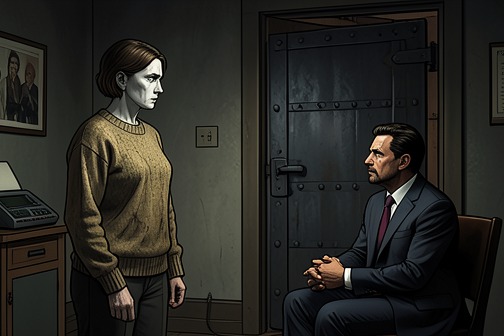
[Hazel Learns Her Father Has Cancer and Agrees to Return to Byron](entity:event-recall-event-hazel-byron-a23599e14097) marks the moment Hazel’s flight from [Byron](entity:character-recall-character-byron-ad5306cf5fcb) collides with her father [Herbert](entity:character-recall-character-herbert-00821e0faa25)’s impending death. The revelation changes the meaning of her choice: returning to [The Hub](entity:location-recall-location-the-hub-b9da9c23498c) is at once a response to a possible chance of treatment and a concession to Byron, whose offer turns her family’s crisis into leverage. Hazel accepts, but frames the decision not as forgiveness or surrender without protest, but as the closest thing to a draw she can secure against him.
## The Diagnosis and Its Credibility
The news arrives while Hazel is already wary of Byron’s account. Before asking about her father, she asks whether [Liver](entity:character-recall-character-liver-606050d7064f) is clean; Byron answers that he has no operative venereal infections, though his body is not in good condition and he would not qualify as an organ donor. Hazel then braces herself for what Byron will say about Herbert, expecting a lie or a half-truth that distorts the whole picture. His disclosure is stark: the cancer is widespread, and Herbert does not have long.
Hazel’s first response is disbelief sharpened by the family history of cancer. Her mother also died of the disease, and Hazel cannot readily accept that her father is now dying of it too. She argues that he had only gone to the doctor the day before and wonders whether something might have produced a faulty reading. Surely, she reasons, he would have symptoms, or his doctors would have found an abnormality in the tests he regularly underwent. Even as she challenges the diagnosis, she catches on a more basic question: why had he gone to the doctor at all?
Byron insists that Herbert knows. He explains that the helmet was not designed primarily as a medical scanner, so its results lack the specificity of a HealthSweep imager, and acknowledges that he is not a doctor. But he says that he has spoken with several doctors on Herbert’s behalf, and that they agree with the assessment. Their available information also indicates that Herbert has already undergone chemotherapy and radiation, then stopped everything except pain-management medication a few months earlier. Byron says he would have checked electronic hospital records as well if doing so were legal, and presents the combination of the scan and medical consultations as enough to speak with certainty.
## The History Behind Hazel’s Shock
The disclosure forces Hazel to confront not only what Herbert concealed but how familiar his concealment has been. She says aloud that he never told her he had cancer or received treatment, and that he then made the decision to die without sharing it. Putting the thought into words is her way of acknowledging its reality. Her doubt about whether Herbert would tell her is also undercut by her own knowledge of him: when he felt worse, he tended to minimize his pain.
She remembers an earlier instance from her high-school years. Before a doctor-ordered stress test, Herbert mowed the lawn despite chest pain, suffered a micro heart attack, and underwent surgery that same day. He left the mower partway through an unfinished strip; it remained in the yard for a week, until an obsessive-compulsive neighbor finished the job. Herbert and Hazel’s mother argued about his decision, but the episode had not changed the pattern Hazel now recognizes: he could play down danger even when it was immediate. The old story makes his silence about cancer more plausible, while also exposing how long Hazel has lived with unanswered questions.
After learning what Byron says the scan and consultations indicate, Hazel reviews other clues she had let pass. She wonders why the hundreds of pills beneath the sink did not prompt her to ask questions, why her father’s urgency about the first and second sex dolls did not strike her as a warning, and why she had not questioned his willingness to spend the rest of his life without a car. She concludes that she had stopped trying to understand his logic so long ago that she no longer questioned either what he wanted or why he wanted it. The diagnosis thus uncovers a second loss: her awareness that habit had made her complicit in not knowing.
## Byron’s Offer and Its Price
Byron presents treatment as a possibility unavailable to Herbert under his current financial circumstances. He says further tests would be needed, but that he could give Herbert access to cutting-edge treatments not available to the general public. He also characterizes his intervention as justified by Hazel’s right to know and by the possibility of helping her father. Hazel immediately sees the leverage beneath the offer. To her, Byron is using Herbert’s health to blackmail her.
Yet the pressure does not produce simple anger. Hazel waits for the offer to sting, but in the moment feels a twisted gratitude: she wants Herbert to receive help, and she can accept Byron winning by a technicality rather than by an achievement of his own. Her response holds together two judgments she does not reconcile. The offer is coercive, but the treatment it might secure matters more than preserving a clean victory over Byron.
## The Return as a Compromised Choice
Hazel understands that accepting the offer means moving back to The Hub. When she asks whether that is what Byron wants, he says it makes the most sense and argues that, if they are together, Herbert is his family and he would do anything possible to help him. Hazel challenges the logic by recalling that Byron is speaking about the father of his estranged wife, whose brain he microchipped. Byron replies that under those circumstances Herbert would sound like an elderly man he was not obliged to help. His answer makes the condition of the offer plain: the assistance is attached to Hazel’s return and to their relationship.
Hazel agrees to come home, but asks to speak with Herbert first and says she will call Byron that night. Her agreement does not erase the conflict she has just named; it is a decision made with that conflict fully in view. She weighs the alternatives in terms of what she could live with afterward. If she refused, she would remember valuing freedom over her father’s life, though she doubts that freedom is complete when Byron can still see and hear what she does. If she returns, Byron will know she has done so out of loyalty to her father, not uncomplicated devotion to him. She considers that imbalance closer to breaking even than a victory for Byron.
As she turns away, Hazel is crying, but cannot attribute the tears to a single cause. She is grieving the news about Herbert and also thinking about petty, specific parts of life at The Hub that she hates, including the purified air in their house, which smells like pencil lead. That detail keeps her return from becoming a clean homecoming: the choice is made under mortal pressure, while her resistance remains present in the ordinary discomforts she already associates with Byron’s world. The scene’s decisive reversal is therefore practical rather than reconciliatory. Hazel goes back because the possibility of helping her father outweighs the compromised freedom of staying away, not because the breach between her and Byron has healed.
Event 12
Jasper's Attempt to Escape the Oceanarium with Bella Is Stopped by Tiny

[Jasper](entity:character-recall-character-jasper-a1e1f2fe4259)’s attempted escape with [Bella](entity:character-recall-character-bella-e7bb6f6c0c73) turns a year of obsessive fantasy into a concrete rescue plan, then exposes the gulf between his imagined partnership and the danger and disorder of his actions.
## Background and Plan
Jasper had long kept a prepared getaway bag for the moment a con went bad. After the Taser incident with Calla, he followed the coast north and used a stolen driver’s license and Social Security card belonging to Larry Winkler to obtain a custodial job at the [Oceanarium](entity:location-recall-location-oceanarium-2724b404a581), which housed five dolphins. He had worked there for more than a year by the time he began planning to take Bella away.
To Jasper, the plan was not simply a theft. He imagined that he and Bella would share a life, even though she would have to remain in water and their relationship crossed the boundary between species. He hoped their courtship would be emotionally rewarding, and left the possibility of sex to Bella’s initiative. This imagined monogamous future also let him recast his fixation as something specific: he told himself that he loved Bella, although every dolphin now aroused him to an intensity he described as medically improbable. At work he tried to conceal his physical response beneath constrictive dance-club briefs and a plastic liner, an uncomfortable improvisation that made the fixation a daily practical problem as well as a private fantasy.
## Preparing the Extraction
The bathtub in Jasper’s apartment was to become the site of his and Bella’s first watery nuptial bed. He had saved filling it for the end of a long morning of preparations: a full cooler waited in the back of his station wagon, whose first two rows of seats he had removed to make room for it. The car’s interior now resembled a hearse, an image he tried not to dwell on. He planned to move Bella from her pool in a veterinary sling used to lift dolphins for medical procedures, cover it with a tarp, and steer clear of security cameras. If someone saw him, he hoped his Oceanarium uniform and the covered load would make it look as though he were removing trash or broken equipment.
The timing depended on the end of his shift, and [Tiny](entity:character-recall-character-tiny-9d42cb1cc18b)’s call to report car trouble made the wait easier. Jasper had not settled on how to handle the supervisor once Bella was discovered missing. He considered planting a false lead by hinting that he planned to travel to Mexico. Alternatively, he might flatter Tiny, confess that captivity troubled him, and suggest that he was contemplating an act others would not understand. Either approach was meant to buy time or sympathy after the escape; even in pursuit of his imagined shared life with Bella, Jasper was planning for the police investigation that would follow.
He had prepared for the Oceanarium’s surveillance with the same anxious ingenuity. The sling folded into a wheeled shape like an ironing board, so he covered its metal frame and bright-blue fabric holster with a sheet. He wrapped himself in separate sheets, leaving his eyes and nose uncovered, and devised a sequence of brief movements separated by a minute of stillness. He edged the sling through the outer door, waited, turned it flat, waited again, then slipped outside and pressed himself against the building as the door closed. In a landscape of cameras, getting out of the medical center became a performance of motion and stillness.
Jasper had cultivated the daytime security guard for information: he brought him coffee, listened to his bowling-league jokes, and used their conversations to study the camera views on the control-panel screens. Remodeling had left a blind spot beneath an extended lip of the holding tank. Jasper meant to draw the dolphins there with sardines, fit Bella into the sling while the others were distracted, and push her the short distance to the car. He knew her four-hundred-pound body would make that difficult, and disliked the sling’s muzzle, wondering whether he could keep her quiet by feeding her instead. At his apartment, sound-capturing foam on the bathroom walls and [Gogol](entity:organization-recall-organization-gogol-6118aef1fc50) noise machines were meant to mask any cries of alarm. The care lavished on concealment and logistics made the plan more elaborate, but did not change its central premise: Jasper treated Bella’s removal as the beginning of a life she had not chosen.
## The Attempt Unravels
When Jasper finally reached the holding-tank room, the dolphins were asleep. Bella’s sleeping face, vulnerable and dreaming, overwhelmed him: her closed eye seemed to him an expression of pleasure, and her gently curved nose a lover’s smile. His arousal was immediate, as he expected, but it did not subside. Instead, it made walking difficult and threatened to derail the extraction he had prepared so carefully. He filled buckets with treat fish for the sling, then questioned whether continuing with the plan was possible while his attraction had left him so physically impaired.
The dolphins were close enough that Jasper decided he could relieve himself quickly and still get Bella out. Climbing the tank steps nearly on all fours, he noticed that the dolphin below the lip was not Bella but Sven, whose Oceanarium biography described him as pensive. Jasper recalled a religious parable about a sick man healed by touching Jesus’s cloak and recast the memory as a possible cure for his own affliction: he decided that touching himself against Sven would resolve it. His plan to take Bella away had thus veered into an immediate violation of another dolphin, without any sign that the animal could consent.
The lights came on before Jasper acted. For an instant he could register only the brightness; then he saw Tiny, holding a long wooden flute and confronting him. Tiny said he understood that workers might resent the animals in their care, but distinguished feelings from actions, describing what Jasper was attempting as torture and comparing it to waterboarding. He offered access to the Oceanarium’s psychologist, but Jasper stood up with his pants down and his arousal visible. His only explanation was that he loved dolphins, collapsing his claim of a particular love for Bella into a fixation plainly directed at dolphins more generally.
Tiny told Jasper to put his pants back on and explained how he had found him: security had noticed the maintenance-office door open and its lights on, and Tiny had come to check because Jasper had no cell phone and might have been injured. Once Jasper dressed and promised not to harm him, Tiny fired him. To avoid revisiting what he had witnessed, Tiny said he would tell others he had caught Jasper stealing cleaning supplies; if Jasper used him as a job reference, however, Tiny would disclose the attempted sexual contact with a dolphin. Jasper quietly corrected the description, saying he had meant to touch himself against the dolphin’s side. Tiny’s response made clear that the attempted escape had ended not in Bella’s removal but in Jasper’s exposure and dismissal.
## Aftermath and Significance
On the drive back to his studio, Jasper wept and careened between lanes. The cooler in his modified station wagon felt not empty but full of dead dreams: the vehicle prepared to carry Bella away now carried the failure of the plan. He imagined driving straight into the ocean from the beach, then dismissed the idea as futile. The car would stall before its rear tires reached the water, and beach patrol would ask for identification; with a stolen license, even that desperate gesture threatened to expose him.
Jasper understood that the attempt had cost him more than the future he had invented with Bella. He had been close to losing his job for fraud already, but tonight, he believed, had been his one chance—and he had blown it. Tiny’s interruption therefore ends both the planned escape and Jasper’s fantasy that a monogamous life with Bella could make his dolphin fixation particular, reciprocal, or harmless. The careful disguises and surveillance tactics could not protect him from the consequences of what he chose to do once he reached the tank.
Event 13
Hazel's Father Dies
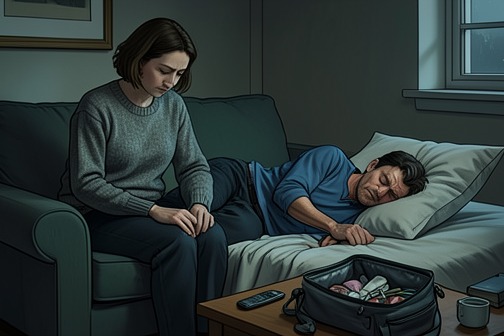
[Herbert](entity:character-recall-character-herbert-00821e0faa25)’s death is the abrupt end of Hazel’s plan to delay medical care until her father could no longer refuse it. She had hoped to bring him to [The Hub](entity:location-recall-location-the-hub-b9da9c23498c) and return to [Byron](entity:character-recall-character-byron-ad5306cf5fcb), but his decline outruns that arrangement. Instead of a hospital-room death, he dies at home, in a scene that leaves Hazel not with revelation or release but with a stunned sense of anticlimax, followed by a decision that puts her own life at risk.
## Causes and Deferred Care
Herbert had been telling Hazel each day that he might have only a few weeks to live. She discounted the warning partly because his predictions had long been colored by extravagant pessimism. Before family vacations in their sedan, he would forecast ruined motels, infected bedsheets, overpriced tourist traps, and even bugs laying eggs in his imagined open sores. The trips never proved so disastrous; on the way home he would announce that they had dodged a bullet. That history gave Hazel reason to expect another false alarm, but this time the familiar gap between his dire forecasts and reality closed. His fever would not break, and he could not keep food down.
Hazel repeatedly begged him to go with her to the medical center. Herbert still had enough strength to spit on the floor and refuse, insisting that he was not leaving and that nobody was asking Hazel to stay. She wished he would ask her to remain, but recognized that his decline was not going to bring the emotional delicacy she wanted. He had asked her to put [Diane](entity:character-recall-character-diane-7eda724cf980) and [Roxy](entity:character-recall-character-roxy-a02d090f59b3) into bed with him. Hazel imagined that his periods of unconsciousness would soon grow deeper and farther apart; she planned to wait until he could no longer fight admission, then call Byron and tell him they were ready. There were bitter things she wanted to say before medical personnel arrived, but she did not want to provoke a final quarrel. Herbert had withdrawn into his own private space and wanted to approach death without an audience, at least not a living one.
## The Death at Home
The immediate sign that something had changed is a low wail from Herbert’s bedroom. Hazel hears it as a raw accumulation of misery, then enters. Her father’s mouth is open as if he is about to speak or sound a note, but his lips remain parted and still. Hazel runs to his side and listens for a final word or even a small noise that might mark the departure of his soul. Instead, the image that presents itself to her is of death entering between his teeth. She calls to him, but there is no response.
Herbert has spent the preceding weeks in a bathrobe. Between the dolls, he looks to Hazel less like the patient in the hospital death she had imagined than like an elderly partygoer who has died in the middle of an incongruous gathering. Her expected version of his end involved a dim room, beeping machines, a hospital bed, and Herbert complaining to an orderly about the flavor of the turkey before collapsing mid-rant. The actual scene is both less dramatic and stranger: he has died at home, dressed only in his robe and surrounded by the dolls she had placed with him. Hazel tells him he went out on top, then qualifies the remark. The joke does not make the death triumphant; its hesitation registers the awkward mismatch between the line and what she is seeing.
After she leaves the bedroom, Hazel hears vague digestive noises and gurgles beneath the covers, compared to the staccato sounds of an engine cooling after a long drive. The bodily detail refuses a clean, ceremonious passage from life into death. It keeps the event close to the ordinary material world even as Hazel tries to make sense of what has happened.
## Hazel’s Response and Immediate Consequences
In the living room, Hazel does not experience the grief she expects herself to feel. Her first response is closer to accepting an anticlimax: major events, she thinks, never seem to feel important enough. Her father has died, yet she feels neither transformed nor especially glum, and she tries to make herself upset about not being more upset. The reaction is not evidence that the relationship meant little to her; the account instead emphasizes the distance between an event’s magnitude and the feeling Hazel can access at that moment.
Practical danger quickly presses in. The clock shows just after four in the afternoon, and Hazel reckons that, at best, she has twenty hours before Byron learns her father is dead. She believes she must return to The Hub; otherwise, no one still living whom she might care about, even briefly, will be safe. The earlier plan—to wait for Herbert’s weakness, then call Byron and take her father for care—has become impossible. Her father’s death leaves her facing a decision about her own return while she is still unable to process the loss.
Instead of acting on that plan, Hazel walks down the hall to the bathroom with a disturbing sense of practiced ease. She swallows a full bottle of Herbert’s heavy opioids with tap water, then goes to the kitchen and drinks large gulps of his cheap whiskey. The sequence makes his death the immediate threshold to Hazel’s suicide attempt: the medicines and liquor are taken from the home and habits that defined his final days, and her deliberation gives way to action.
## Thematic Significance
The death turns a familiar family pattern inside out. Herbert’s earlier forecasts of disaster had repeatedly exceeded what happened; now Hazel’s expectation that his condition might still allow time for a managed transition proves misplaced. The story’s recollection of her mother explaining that looking at what is not beautiful is looking at reality sharpens the contrast between imagined endings and the unadorned one Hazel witnesses. There is no hospital tableau, final speech, or sudden emotional insight to organize the loss for her.
The scene also makes the end of Herbert’s life a point of entanglement rather than closure. His refusal of care, Hazel’s delayed call to Byron, the presence of Diane and Roxy, and her urgent fear for the living converge in a cramped domestic aftermath. Herbert is dead, but Hazel cannot settle into mourning: the limited time she believes she has before Byron discovers the death and her sense that others may be endangered press her toward The Hub, while her immediate action moves in the opposite direction. The anticlimax of grief thus becomes the prelude to a crisis, not a resolution.
Event 14
Liver Disappears; Hazel Finds Gogol Has Taken Over His Home
[Hazel Green](entity:character-recall-character-hazel-green-c5bccb2c7d7a)’s search for [Liver](entity:character-recall-character-liver-606050d7064f) turns an absence into a confrontation with [Byron Gogol](entity:character-recall-character-byron-gogol-96663d0c1b1d)’s power to control what can be seen, found, and believed. At [The Spotted Rose](entity:location-recall-location-the-spotted-rose-cf327eec67c5), Liver’s usual absence is alarming; at his former home, his shed has vanished beneath [Gogol](entity:organization-recall-organization-gogol-6118aef1fc50) Industries’ claim, and a necklace of teeth appears in a safe waiting at Hazel’s father’s house. [Byron](entity:character-recall-character-byron-ad5306cf5fcb) does not confirm what happened to Liver. Instead, he denies that Liver exists, while pressing Hazel to return. The scene makes the missing man’s uncertain fate inseparable from Hazel’s struggle to trust her own knowledge.
## The Search Begins
At The Spotted Rose, Hazel asks the bartender whether she has seen Liver. The bartender says he has been absent all evening, which she describes as unprecedented. Because Liver is always there, she fears that something has left him physically unable to come: perhaps he is badly injured or dead. She suggests an emergency room, but doubts he would go by himself. Her warning does not establish what has happened; it gives Hazel a reason to act before she knows.
Hazel asks to borrow the bartender’s car. To explain why she is concerned, she tells her that she slept with Liver and that her ex found out. She wants to check on him, whose dwelling is far away, and thinks she can remember the route. The bartender is suspicious about the relevance of Hazel’s disclosure, then hands over the keys with a warning about the consequences if Hazel is stopped while driving the car. Hazel refuses the suggestion that she might steal it. That refusal leads into her reflection on how social pressure can make her agree vaguely before she understands what she is agreeing to. After her marriage, she has come to regard knowing the full story as necessary to giving genuine consent. The exchange gives the search a second stake: Hazel is trying to respond to concern without surrendering her judgment to someone else’s assumptions.
On the way to Liver’s shed, Hazel notices a shoe in a tree and wonders whether it belongs to him. She cannot remember whether he wore shoes when she last visited, sees no matching shoe, and cannot explain why he would have climbed the tree. The small, inconclusive clue sharpens rather than resolves her uncertainty. She begins to run, then sprints; she recalls that during her life with Byron Gogol she felt an urge to stay still and blend into the wall. Now her movement carries her toward evidence she cannot yet interpret.
## The Shed and the Safe
Liver’s shed is gone. In its place stands a sign declaring the area to be Gogol Industries property and warning that trespassers will be reported. A camera mounted on a stick turns to focus on Hazel and takes several pictures. The combination of the ownership notice and the camera makes the site more than an empty dwelling: it has been claimed, and Hazel’s presence is being recorded. She runs rather than staying to challenge the sign or investigate the camera.
Hazel heads directly to Hazel’s Father’s Home, leaving the car a few blocks away with the keys inside. In the backyard, she expects to find another safe containing a phone, as though the one she had pawned had never been removed. She understands the replacement as part of a repeating arrangement: she could dispose of the safe every day, and another would be waiting by morning. The safe therefore offers access to Byron as well as a reminder that discarding the device does not end his reach.
When this safe opens, its electronics are the same, but Liver’s necklace of teeth is draped across them. The object connects the controlled mechanism to Liver, but does not explain whether he is alive, where he has gone, or how the necklace came to be there. Hazel’s discovery is disturbing precisely because it supplies a tangible trace without giving her the certainty she needs. She turns to Byron’s already-open video call and asks whether he had Liver arrested, while demanding that he let him go. The question is Hazel’s suspicion, not confirmation of an arrest.
## Byron’s Denial and Offer
Hazel tells Byron that she will return as soon as she knows Liver is okay, even if her father refuses treatment. She describes the bargain as a hostage trade: her return in exchange for assurance about Liver. That offer shows how the disappearance has changed Hazel’s immediate priorities. She is willing to leave her father’s position unresolved if doing so can keep another person from being harmed, but she makes her return conditional on evidence that Liver is safe.
Byron responds warmly to the prospect of Hazel coming home and asks whom she means when she refers to Liver. Hazel asks whether Byron had him killed. Byron’s answer is not a direct account of Liver’s whereabouts: he treats Liver as an imaginary person and argues that a search online would yield no trace. In contrast, he says, Hazel is publicly documented in photographs and as his wife. Hazel replies that she is living in a reality different from the Internet’s. The exchange sets Byron’s searchable record against Hazel’s immediate experience, exposing how a system that makes her visible can still be used to deny someone important to her.
Byron then presents Hazel’s public visibility as a rescue from anonymity and invites her to regard herself as an integral partner in a large project and his legacy. He points to millions of dollars of work and groundbreaking research, and urges her to come home with her father, whose life might still be saved. His appeal joins promises of recognition and medical help to the pressure already established by the camera, the safe, and Hazel’s fear for Liver. The call does not resolve the disappearance; it redirects the conversation toward the return Byron wants.
## Delay and Uncertainty
Rather than answer Byron’s demand directly, Hazel says that she needs time to mourn Liver and frames that mourning bitterly as grief for someone who supposedly never existed. The remark repeats Byron’s denial in a form that exposes its cruelty: Hazel is being asked to accept the absence of public proof as proof of absence, even with Liver’s necklace in front of her. Byron permits her to delay, but tells her not to test his patience and says she can grieve at [The Hub](entity:location-recall-location-the-hub-b9da9c23498c). He even offers to arrange a black veil, turning her grief into something he can accommodate within the life he is asking her to resume.
After the call ends, Hazel finds herself in the backyard, crawling toward the sliding-glass door and sitting with her forehead against it. The scene ends without confirming Liver’s fate or showing Hazel return to Byron. Instead, it leaves her between two incompatible accounts: the trace of Liver at a site taken over by Gogol Industries, and Byron’s insistence that Liver has no discoverable existence. The disappearance thus functions both as a search for a missing person and as a test of who gets to define reality when one party controls the records, the property, and the means of surveillance.
Event 15
Jasper’s empathy neurosurgery
[Jasper’s empathy neurosurgery](entity:event-recall-event-jasper-s-empathy-neuros-b270e70b063a) is an experimental intervention in which [Voda](entity:character-recall-character-voda-d0f49719e80f) tries to alter [Jasper](entity:character-recall-character-jasper-a1e1f2fe4259)’s brain after a dolphin attack has left him with a sexual fixation she cannot promise to reverse. The operation seems to meet his immediate request, yet its lasting consequence is not a simple cure: Jasper develops an intense new capacity for empathy, accompanied by guilt and regret that neither he nor Voda anticipated in that degree.
## Background and Uncertainty
Jasper seeks treatment because his sexual response has changed after a dolphin attacked him. When he asks whether Voda can cure him, she resists the word: it implies a clean restoration, she explains, while the cause and workings of his altered brain remain uncertain. She warns that undoing what has happened would be difficult precisely because they do not know how or why it happened. Her careful qualification establishes the procedure as experimental, not a guaranteed return to an earlier state.
Voda has already gathered more information than Jasper supplied during his phone consultation. She tells him that her diagnostics have filled in what he left vague, and she indicates that his case interests her for several reasons. The scene therefore places the operation between Jasper’s urgent wish for relief and a practitioner who recognizes both the limits of available knowledge and the unusual possibilities of his case.
The novel’s other medical crises sharpen the question of intervention without making them part of Jasper’s operation. Hazel had not consented to [Byron](entity:character-recall-character-byron-ad5306cf5fcb)’s proposed brain-to-brain connection, which he presented as research and development; her headaches and first nosebleed were detected by the household’s SmartFilter and prompted his remote suggestion that she see a doctor. Separately, Hazel learns that her father has undergone cancer treatment and then stopped everything except pain medication; when she urges him to pursue further treatment, he says he is done. Against these contrasting decisions, Jasper’s willingness to try an uncertain procedure matters: consent is present, but it does not erase the uncertainty of what medicine may change.
## The Procedure
Before beginning, Voda asks Jasper’s permission and says that, because he is restrained, she can take responsibility for the physical exertion. Jasper agrees and closes his eyes. During the procedure, he experiences what seems to him to be a dolphin encounter associated with [Bella](entity:character-recall-character-bella-e7bb6f6c0c73), the dolphin he knows from the [Oceanarium](entity:location-recall-location-oceanarium-2724b404a581). The experience is sufficiently convincing that he believes the intervention has reached the precise response he hoped to recover.
The operating-room scene deliberately blurs the border between imagined encounter and clinical procedure. Jasper’s attention is absorbed by the simulation; when he opens his eyes, the sound he had associated with an audience is actually the surgical crew applauding. Voda, having finished the intervention, tells him that it worked and checks whether he agrees. Jasper quietly describes the experience as having felt like sex with a dolphin. The report is his immediate measure of success, while the team’s applause makes that private sensation into a publicly witnessed clinical result.
## Immediate Outcome and Aftermath
Once freed from the restraints, Jasper feels winded and notices his racing pulse. Voda’s team helps him dress and invites him to a reception, where he is offered food and assistance with his appetite. Jasper begins to smile with the practiced expression he used after a successful con. Yet the expression feels unfamiliar: although it resembles his former self, he feels as if everything in him has been replaced. The operation’s immediate success is therefore accompanied by an unsettling estrangement from the person who entered the procedure.
The deeper consequence becomes clear over the following month. Jasper increasingly cries in Voda’s atrium, among porcelain succulents and other artificial plants. One evening he loses track of time and weeps in the dark. When Voda finds him, he apologizes and pleads not to be expelled, insisting that he is not as awful as he once was. Voda identifies the state as an excessive amount of empathy, arriving all at once in what she calls an empathy puberty. She admits that she did not intend the stimulation to have this effect.
Voda then discloses that her intended outcome was personal as well as neurological: she wanted Jasper to fall in love with her, live with her, and continue their convenient sexual arrangement. She had expected the brain stimulation to have little effect on his conscience. Instead, a month after the operation, Jasper is overwhelmed by regret. He feels guilt about estranged family relationships, including his distance from his father and his failure to contact his mother after she left. What had been designed to serve Voda’s domestic and sexual convenience has become an involuntary moral reckoning for Jasper.
## Significance
The procedure’s reversal lies in the difference between its apparent and lasting results. At first, the simulated encounter seems to deliver exactly what Jasper requested; afterward, the new empathy changes how he experiences his past and his relationships. The surgery does not simply remove an unwanted symptom. It produces a broader transformation whose emotional costs Voda herself did not foresee.
The event also complicates the language of cure. Voda’s initial caution acknowledges that the brain’s change cannot be confidently traced or reversed, while her later admission shows that she nevertheless proceeded with a specific personal objective. Jasper consented to begin the procedure, but he did not agree to the unanticipated scale of its effects or to the use of neurological stimulation as a means of securing his attachment. The operation thus turns technical uncertainty into a question of responsibility: consent to an experiment does not make its consequences predictable, and a practitioner’s hoped-for outcome may differ sharply from the life the intervention actually creates.
Event 16
Hazel’s escape from Byron
[Hazel’s escape from Byron](entity:event-recall-event-hazel-s-escape-from-byr-5b7e8eabf5e4) is a rescue carried out under the pressure of two immediate threats: the brain chip that subjects her to downloads and the danger of leaving her father’s body behind. [Jasper](entity:character-recall-character-jasper-a1e1f2fe4259) arrives with an injection meant to deactivate the chip, but finds Hazel apparently dying from an overdose. The escape therefore begins not as a clean departure but as an improvised effort to keep her alive, interrupt [Byron](entity:character-recall-character-byron-ad5306cf5fcb)’s control, and take her father with her before the next download can occur.
## Causes and Stakes
The plan originates with the rabbit woman, who tells Jasper that Hazel has been subjected to the same kind of brain manipulation as he was, but much more severely. She offers him a syringe that she says will deactivate Hazel’s chip and casts the rescue as a chance to make amends for his past wrongdoing. The proposed action is explicitly dangerous: Jasper is asked to put his life at risk as proof that his remorse has become something more than a feeling.
The rabbit woman has also watched Hazel’s downloads and gives Jasper a practical point of entry: the trailer’s back sliding-glass door, if no one answers the front. She warns him to avoid a hospital if possible. If Hazel is identified there, Byron could be contacted and take her into his private care; she might then remain under his control and, according to Jasper’s fears, under round-the-clock surveillance. The rescue’s stakes are thus not limited to stopping a download. Saving Hazel physically while returning her to Byron would not secure her freedom.
## The Rescue at the Trailer
Jasper approaches in a fake parcel-delivery uniform, carrying the shot in a lunch-pail cooler. When the people inside do not wake, he slides open the glass door and enters. He discovers that some of the figures on the bed are dolls, then sees the signs of Hazel’s overdose: blue-tinged lips and a discarded pill bottle. Her father’s corpse lies nearby. Jasper initially believes Hazel is dead, and his first response is to imagine how her body might be repositioned before paramedics arrive—an awkward, practical impulse that contrasts with the heroic role the rabbit woman has assigned him.
Hazel then makes a gurgling sound, and foam gathers at her mouth. Jasper understands that she needs urgent medical help but does not know what action to take. He searches the rooms for a [Gogol](entity:organization-recall-organization-gogol-6118aef1fc50) phone or computer to find overdose instructions, caught between calling paramedics and fearing that a hospital would put Hazel back within Byron’s reach. He decides to administer the injection while he tries to buy time. At that point, the chip treatment and the overdose response are entangled: the shot is part of the escape plan, but it does not by itself resolve the immediate medical crisis.
The danger escalates when a man enters with a gun and demands to know whether Hazel is alive or whether Jasper intends to kill her for the chip. Jasper explains that he came to deactivate it so Hazel could escape her husband, that he has only just arrived, and that he found Hazel overdosed beside her dead father. The armed man responds by forcing Hazel to vomit up partly digested pills and judges that she will live. That intervention changes the scene from a possible rescue attempt ending in death to a precarious chance to get Hazel out.
## The Flight Takes Shape
Once Hazel is conscious enough to speak, Jasper identifies himself and explains that he has given her an injection intended to disable the chip. Hazel’s response is to warn that Byron will kill him. Rather than treating that danger as a reason to abandon the plan, Jasper agrees that they must leave before Hazel’s next download. The deadline gives the escape its urgency: they cannot wait for a safer or more orderly opportunity without risking another episode of Byron’s control.
Hazel does not accept flight as a private rescue that concerns only her. Looking at the covered body of her father, she insists that they cannot leave him behind. She fears Byron could use the corpse as cryogenic blackmail, making the body itself a means of coercion even after death. Jasper agrees to take it, while [Liver](entity:character-recall-character-liver-606050d7064f), who has returned, helps cover the corpse’s face. His presence establishes that the departure is not simply Jasper carrying Hazel away: Liver is also there, and the group’s immediate problem includes transporting a body without attracting notice. Jasper says they will need to keep it cold in the sunny weather and notes that people might recognize the smell of death. The escape is consequently bound to an improvised and difficult task, not just a change of location.
## Aftermath and Narrative Significance
The promised escape is presented as a sequence of contingent decisions rather than a completed, uncomplicated break. The injection is given; Jasper and Hazel agree to move before the next download; and Hazel’s insistence on taking her father turns the departure into a joint undertaking with Liver. The available account does not show the journey’s full outcome, but it does show Hazel choosing what the rescue must include. She refuses to make her father’s body the price of her own escape, even when carrying it makes the plan harder.
As the download time approaches, Hazel stands at a sink with the faucet running in case the episode makes her vomit. It does not happen. She vomits anyway, describing the action in her thoughts as a way to avoid an anticlimactic start to a new life and to make her gratitude unmistakable. The gesture is comic and self-conscious, yet it marks a real shift in her position: she is no longer waiting passively for the download, and the scene associates her new beginning with bodily action rather than with a triumphant declaration. Her escape from Byron is both technological and physical, but its first sign of freedom is modest and unsettling—the expected violation does not arrive, while Hazel still has to reckon with the crisis already inside her body.
Event 17
Hazel’s father’s funeral
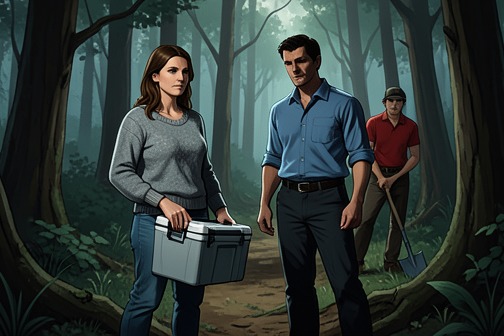
[Hazel’s father’s funeral](entity:event-recall-event-hazel-s-father-s-funera-f09ab2c0c6c5) is not a conventional service but a secret, improvised farewell, shaped by Hazel’s fear that [Byron](entity:character-recall-character-byron-ad5306cf5fcb) may discover her father’s body. In the woods, a cooler serves as both the practical means of transporting the body and the center of the gathering. Hazel and [Jasper](entity:character-recall-character-jasper-a1e1f2fe4259) say little; [Liver](entity:character-recall-character-liver-606050d7064f) offers to stay behind and manage the burial. The scene makes mourning inseparable from concealment, while its small gestures allow Hazel to remember her father and choose what should continue after him.
## Background and Constraints
Hazel’s father had died at home. When Hazel entered his bedroom, she found him motionless, his mouth open and his lips frozen apart. His death did not resemble the hospital scene she had imagined for him: he had spent his last weeks in a bathrobe among the dolls, not in a room of medical equipment. Hazel’s recollection of his final appearance establishes the personal loss that the funeral must address, even as the circumstances prevent an ordinary public ritual.
The need for secrecy determines what kind of farewell is possible. Hazel believes Byron could search for her father’s remains whether or not the attempt to deactivate her brain chip has worked. She therefore rules out a normal burial: the body must be completely gone by noon the following day, before Byron can use it to trace or investigate her. That deadline turns the funeral into a practical crisis as well as an act of mourning.
Liver assesses the proposed options in terms of time and equipment. He warns that a fire hot and sustained enough to destroy the body’s DNA would take longer than they have, even with an empty metal Dumpster and an accelerant. He proposes consumption instead. The exchange conveys the extremity of their predicament without resolving every logistical detail. The funeral later moves toward a burial, but the account does not show the burial itself or explain exactly how the earlier deadline is reconciled with that plan.
## The Gathering in the Woods
Liver chooses a secluded spot with trees and shrub cover. The group sets the cooler down there, and Jasper and Liver return to the car to bring back the dolls, [Diane](entity:character-recall-character-diane-7eda724cf980) and [Roxy](entity:character-recall-character-roxy-a02d090f59b3). Hazel remains beside the cooler as dusk approaches. She sits on it for a moment before remembering what it contains and getting back up. Thirst makes the cooler briefly suggest drinks to her, an ordinary expectation that collides with the knowledge of her father inside. The scene lets grief surface through a mundane reflex rather than a formal speech.
The dolls become part of the ceremony because Hazel had already imagined them accompanying her father. She had considered granting him a kind of pharaoh’s exit, with the dolls going along with him. At the woods, however, she hesitates over placing them in the ground. They seem too animated, even in stillness, for burial, and she wonders whether her father would rather they stay alive in the world and enjoy themselves. Her choice about the dolls becomes the funeral’s clearest decision about what is to be surrendered and what might continue.
## Words for Her Father
When Liver asks whether they should say a few words, Jasper answers that her father was already dead when he met him. Liver responds lightly, then notes that Hazel’s father spoke his mind, a quality he considers valuable, though not always. Their brief exchange does not produce a polished eulogy. Instead, it leaves Hazel to identify what she herself remembers and values.
Hazel recalls that her father had managed not to become addicted to many things, which she regards as impressive in someone who lived to old age. To her knowledge, he never deliberately tried to ruin anyone’s life. Most simply, he sometimes made her laugh. The modesty of these memories gives the farewell its personal measure: Hazel does not present him as flawless or reduce him to his illness and death. She remembers habits and limits, then settles on the laughter he gave her.
Jasper suggests giving the dolls voices, imagining them speaking as if they were in love. His suggestion draws on his own recent experience of love and loss, and he begins to cry. Hazel recognizes that his tears are not technically for her father, but accepts them as part of the funeral all the same. The scene allows grief to be shared without requiring every person’s sorrow to have the same source.
## Parting and Aftermath
Liver offers to remain with the cooler and handle the burial. He says he will place explosives with it so that anyone who tries to disturb the body will be deterred, and that he will sit by the grave for a while. He also acknowledges that he tends to stand out in certain situations, presenting his decision to stay as a way to spare Hazel and the others that difficulty. His offer is a practical service, but it also makes him the one who will keep watch after the others leave.
Hazel asks whether he will bury the dolls with her father. She then revises the idea, asking whether they could stay with Liver instead. He agrees to try to show them a good time. As he wheels the cooler away from the path, he carries one of the dolls tenderly in his arms. Hazel walks toward the car and, before turning back, looks once more toward the brush where Liver has disappeared. The closing image joins the body’s concealed passage with the dolls’ continued presence: the farewell separates Hazel from her father, but entrusts the objects she had nearly buried to someone who will care for them.
## Significance
The funeral is defined by the gap between ordinary mourning and the actions forced on Hazel by surveillance. She would prefer a conventional burial, but fears that Byron could find the body; secrecy and the deadline therefore shape the ceremony from its setting to its proposed handling of the remains. The woods provide a private place to speak, not a secure return to normal life.
At the same time, the scene restores some room for Hazel’s own judgment. She remembers her father in her own terms, accepts Jasper’s imperfect but sincere participation, and changes her mind about the dolls. The ending does not confirm that the burial has been completed. Instead, it leaves Hazel walking away while Liver takes responsibility for the cooler and the dolls. The funeral’s resolution is thus a transfer of care, not a public or fully witnessed conclusion.
Event 18
Byron Gogol’s Death
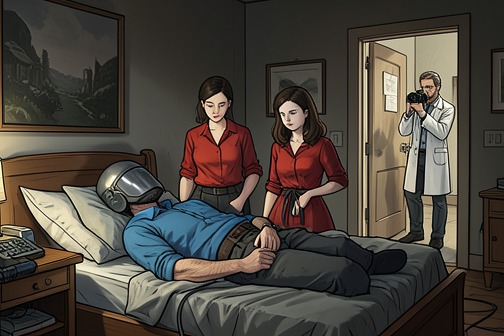
[Byron Gogol’s Death](entity:event-recall-event-byron-gogol-s-death-41885d4821c0) is presented through leaked bedroom-security footage and the competing explanations that follow it: the public account describes a catastrophic helmet malfunction, while Hazel concludes that [Fiffany](entity:character-recall-character-fiffany-df48131f003e) deliberately caused [Byron](entity:character-recall-character-byron-ad5306cf5fcb)’s death. The distinction matters beyond the question of who killed him. The footage exposes the persistence of surveillance Byron had claimed was switched off, and the aftermath shifts control of [Gogol](entity:organization-recall-organization-gogol-6118aef1fc50) from him to Fiffany, whose prospective policies appear to reject some of his company’s defining ambitions.
## The Footage and the Official Account
The video, taken from [The Hub](entity:location-recall-location-the-hub-b9da9c23498c)’s bedroom security cameras, reaches Hazel and [Jasper](entity:character-recall-character-jasper-a1e1f2fe4259) through media coverage. It shows Byron and Fiffany lying side by side, both wearing sleep helmets. Byron sits upright, moaning and intermittently clutching at his helmet and chest. Fiffany removes her own helmet, shakes out her hair, and tries to work out what is wrong. Byron cannot get his helmet off, and the recording presents his distress as escalating rather than resolving.
The footage also unsettles an earlier assurance: when Hazel first moved into The Hub, Byron had sworn that the bedroom cameras shut off at night. The leaked recording makes clear that they did not. His death is therefore revealed to the public through a system of observation he had kept operating, even as his claims suggested otherwise. The cameras preserve the crisis but cannot, by themselves, settle what caused it or establish Fiffany’s intent.
The account circulating publicly is that the helmet would not come off because of a software glitch or another technical failure, perhaps affecting Byron’s brain waves, and that he panicked into a heart attack. Hazel rejects this explanation. In her view, safeguards should have prevented such a malfunction, and the apparent failure was intentional. The available footage shows the helmet trapping Byron and his attempts to escape it; the claim that Fiffany made this happen is Hazel’s conclusion, not something the recording independently proves.
## Hazel’s Reading of Byron’s Last Moments
As the video continues, Byron tries to break the helmet free by striking his head against the wall. He first stands, then ends up on all fours, knocking his head against the ground until he can no longer continue. The black-and-white recording does not convey intelligible words from him; the helmet muffles any possible speech, while Fiffany’s apparently frantic screams further obscure it. Hazel judges Fiffany to be acting. Her certainty comes not from a clear confession or an unambiguous image, but from reading the scene against what she knows of the helmet’s safeguards and the circumstances shown.
Hazel imagines that Byron understood, just before dying, that Fiffany had outsmarted him. She also chooses to reinterpret the footage as if he were recognizing his own errors and beating his head against the ground in response. That imagined meaning does not change what the recording can establish, but it reveals the emotional distance she is trying to put between herself and the man’s final panic. Her account of the death is at once an accusation and a way of recasting a frightening image as a reckoning.
The public explanation offers Hazel a measure of relief: the wider world blames a failure in technology Byron created. Yet she admits that part of her wishes that explanation were true. If the helmet simply failed, the death would not require accepting that Fiffany had intentionally killed him; but it would also mean Byron’s system had failed on its own terms. Hazel observes that he died without having been defeated by a technological error. Jasper counters that death is not a victory. Their exchange keeps the event’s moral meaning unsettled: Byron’s death ends his control, but it does not make the manner of his death feel like justice to Hazel.
## Fiffany’s Suspected Role and Rise
Hazel suspects that Fiffany may also have helped leak the footage. Jasper wonders whether someone at the police station released it, but Hazel doubts most workers would risk a lawsuit from Gogol and thinks Fiffany may have had a hand in making the recording public. She allows that the leak might have been intended as an apology to her. This remains speculation rather than confirmed information, but it links the footage’s exposure to the same person Hazel believes caused Byron’s death.
The coverage reports that Fiffany is requesting privacy during a difficult time, while news channels are confirming that she will be named Gogol’s new CEO. The transition makes the killing politically consequential: the video that displays Byron’s helplessness circulates as the company prepares to pass into Fiffany’s hands. Hazel’s response is not simple celebration. She had misunderstood Fiffany’s ultimate pursuit, taking it to be Byron when Hazel now believes it was the company. In this revised interpretation, Fiffany’s action may have removed Byron and preserved the wider world from some of his plans, even as the evidence of murder remains circumstantial.
## The Company After Byron
Television discussion turns from the death to what Gogol might become under Fiffany. A new vice president discusses possible changes, none of the projected initiatives including brain melds. Fiffany is also reported as likely to withdraw from several of Gogol’s weapons contracts and to increase its humanitarian initiatives, with art and education technologies named as areas of interest. These are prospective directions reported in the aftermath, not completed reforms, but they sharply contrast with the company associated with Byron.
Hazel and Jasper raise their bottles to the new CEO, echoing the same salute twice, first Jasper’s and then Hazel’s. The gesture registers a transfer of power while leaving Hazel’s judgment divided: she can welcome the possible change in Gogol without celebrating the means by which Byron died. The death thus closes Byron’s personal command and opens a contested future for the company. Its public meaning remains split between a supposed technology failure and Hazel’s conviction that Fiffany turned Byron’s own system against him.